


Page 32 - Revista FEARP 21 2
P. 32
(02) Estudio descriptivo de la evolución exèrimentada por los usuarios del programa de promoción de la autonomía en el propio domicilio  (02) Estudio descriptivo de la evolución exèrimentada por los usuarios del programa de promoción de la autonomía en el propio domicilio


        Introduction                                                                                                           Conclusions

        Many people with severe mental disorders (SMD) struggle to meet their housing and care needs by themselves.            The results of this study confirm that the Home-Based Autonomy Promotion Service (SPAPD) contributes to
        Said disabilities, resulting from their psychiatric condition, interfere with the necessary processes of finding,      improving the quality of life of its users, both from an objective evaluation and their subjective assessment (per-
        accessing, and maintaining housing options that align with their preferences and needs. Inadequate housing             ception of their own clinical stability, quality of life, autonomy, and the adoption of healthy habits).
        coverage contributes to a range of negative consequences, such as: inappropriate use of hospital care, leading         Intensive training in social skills, combined with a helping relationship focused on strengthening the individual’s
        to an increase in the “revolving door” phenomenon and challenges in deinstitutionalization. Housing must be at         abilities, has long-lasting and significant effects on reducing negative symptoms and significantly improving
        the core of community psychiatry, as it is where a person feels they belong and identifies with the community.         social competence, by boosting their self-esteem.
        It is essential to enable these individuals to live as independently and normally as possible, which requires
        providing the necessary support to foster autonomy and help them cope with the demands and challenges                  Working in a safe environment, such as their own home, offers a number of benefits compared to other living
        of their environment. Prioritizing residence in one’s own home, as far as the individual’s capabilities allow it, is   arrangements, such as: the promotion of community roles in normal environments versus the role of a patient
        considered important, ensuring the necessary support measures over more restrictive housing options.                   or service user in a residential setting; greater participation and control of daily activities by those assisted by
        In this context, the present study aims to evaluate the progress of users of the Home-Based Autonomy Promo-            the SPAPD, as opposed to unilateral control by the care team; normalized social integration versus grouping by
        tion Service (SPAPD) by the CPB Mental Health-Dr. Josep Fábregas Foundation over their first five years with           psychiatric labels or disabilities; “live” training with flexible and individualized support versus standardized and
        the service, with the purpose of demonstrating  that individuals with severe mental disorders (SMD) can live           predetermined levels of care.
        successfully in the community with the appropriate support.
                                                                                                                               Keyword:
        Method                                                                                                                 Severe Mental Disorder, Living Environment, Home-Based Support, Community Integration

        It consists of a cross-sectional longitudinal study conducted with an initial sample of 47 users of the Home-Ba-
        sed Autonomy Promotion Service, a group that has been engaged with the service from 2015 to 2023.
        The variables used include: changes in the ENAR-CPB scale (at admission, at 2 and at 5 years); psychiatric
        hospitalization days for each user, based on the year prior to their enrollment and the year following; and the
        subjective perception of change according to the satisfaction survey (administered annually).


        Statistical analysis was performed using IBM-SPSS v.19. Descriptive statistics were evaluated for the variables
        studied, with parametric statistics applied and the T-Test used for continuous variables.


        Results
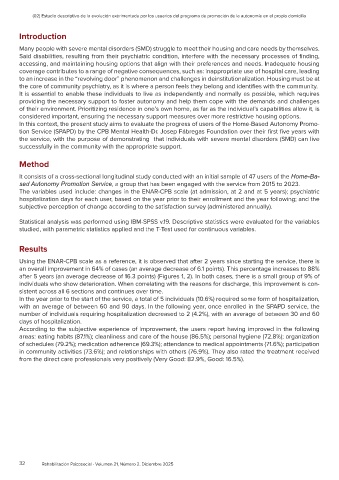
        Using the ENAR-CPB scale as a reference, it is observed that after 2 years since starting the service, there is
        an overall improvement in 64% of cases (an average decrease of 6.1 points). This percentage increases to 88%
        after 5 years (an average decrease of 16.3 points) (Figures 1, 2). In both cases, there is a small group of 9% of
        individuals who show deterioration. When correlating with the reasons for discharge, this improvement is con-
        sistent across all 6 sections and continues over time.
        In the year prior to the start of the service, a total of 5 individuals (10.6%) required some form of hospitalization,
        with an average of between 60 and 90 days. In the following year, once enrolled in the SPAPD service, the
        number of individuals requiring hospitalization decreased to 2 (4.2%), with an average of between 30 and 60
        days of hospitalization.
        According to the subjective experience of improvement, the users report having improved in the following
        areas: eating habits (87.1%); cleanliness and care of the house (86.5%); personal hygiene (72.8%); organization
        of schedules (79.2%); medication adherence (69.3%); attendance to medical appointments (71.6%); participation
        in community activities (73.6%); and relationships with others (76.9%). They also rated the treatment received
        from the direct care professionals very positively (Very Good: 82.9%, Good: 16.5%).


        32      Rehabilitación Psicosocial · Volumen 21, Número 2. Diciembre 2025                                                                                                 Rehabilitación Psicosocial · Volumen 21, Número 2. Diciembre 2025  33

